Indigenous women sound alarm over growing threats from conflict, inequality
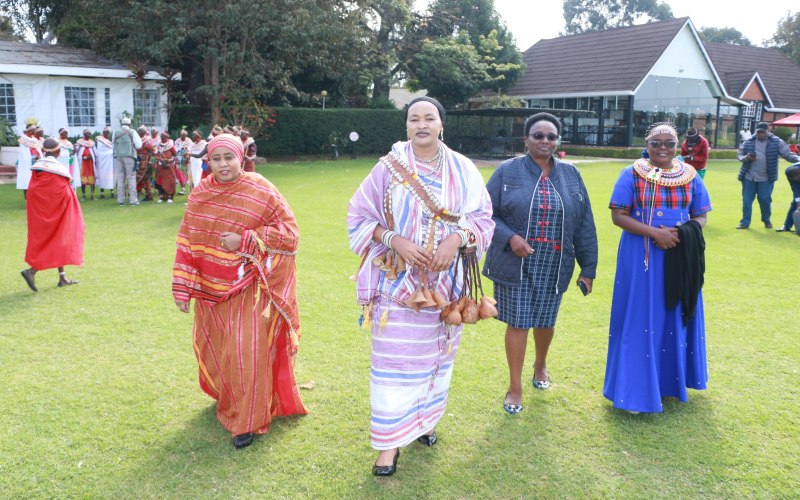
Participants urged policymakers, development partners, and human rights defenders to step up efforts to end violence against indigenous women and girls and to promote sustainable development and lasting peace.
Indigenous women in East and Central Africa are confronting escalating violence, worsened by environmental changes, forced land evictions, and longstanding social inequities.
At the seventh East Africa Indigenous Women-led Assembly in Dol Dol, Laikipia County, participants said structural inequalities, limited political voice, harmful traditional practices, and restricted civic engagement leave them exposed to abuse and exploitation.
More To Read
- KNCHR report casts doubt on Kenya’s commitment to refugee protection
- Senate Bill proposes two-year deadline for land court cases
- High Court nullifies law limiting NLC’s timeline on historical land cases
- National Land Commission directs State to conclude Ogiek resettlement
- Residents to receive Sh500 million compensation for Isiolo-Garbatulla-Modogashe road project
- Motion filed seeking probe into irregular land allocation in Nairobi County
The assembly, held at the close of the 16 Days of Activism Against Gender-Based Violence and International Human Rights Day, highlighted the heavy toll on indigenous women, who are disproportionately affected by physical and sexual violence, exploitation, and cases of disappearance or murder.
Research shows these dangers are most severe in pastoralist and hunter-gatherer communities, where access to essential resources is limited.
Reports indicate that female genital mutilation remains a serious concern in some communities, affecting the Somali (98 per cent), Kisii (96 per cent), and Maasai (73 per cent) populations.
Ongoing conflicts over scarce water and pasture increase women’s exposure to harm, as they travel long distances to provide for their families while facing the risk of assault or wildlife attacks.
Neema Alayana Laizer, a Maasai from Tanzania, described the daily hazards: “Some women are beaten by their husbands for returning late, having fetched water from far-off areas. When we lose our cattle, it is women who must feed and clothe their families.”
Libaku Philippe from the Batwa community in the Democratic Republic of Congo explained how evictions from the Kahuzi-Biega forest destroyed livelihoods and restricted access to economic and medicinal resources. Conflicts in eastern Congo have intensified these pressures, leaving women in an even more precarious position.
In Kenya, land dispossession continues to fuel vulnerability among women. Judy Kipkenda, executive director of the Koibatek Ogiek Women and Youth Network, said that during evictions, women are more likely to face physical abuse if they cannot support their families, with poverty also driving early and forced marriages.
Despite these challenges, the assembly has strengthened indigenous women’s advocacy, legal gains, and collective voice. Neema noted that the forum has empowered women in patriarchal societies to demand their rights.
The meeting called for better access to justice, culturally sensitive protection systems, secure land rights, economic empowerment, and stronger leadership roles for women, recognising their central role in safeguarding culture, biodiversity, peace, and community wellbeing.
This year’s gathering brought together leaders and grassroots defenders from diverse indigenous communities, including the Ogiek of Mau and Mt Elgon, Maasai of Kenya and Tanzania, Batwa of
Uganda and the DRC, Sengwer, Aweer, Yaaku, Wayyu, and allies from the Nairobi Social Justice Centre.
Participants urged policymakers, development partners, and human rights defenders to step up efforts to end violence against indigenous women and girls and to promote sustainable development and lasting peace.
Top Stories Today